

Atlanta Junk Removal Services
Schedule now and watch your property transform with same-day pickup and stress-free hauling!
Get a Free QuoteExpert Junk Removal Solutions for Atlanta's, GA Diverse Property Needs
Atlanta’s Trusted Partner for Residential and Commercial Junk Removal
Atlanta’s unique blend of historic neighborhoods and bustling business districts creates a variety of junk removal challenges throughout the year. In residential areas, winter storms can leave behind debris and damaged outdoor items, while spring renovations in communities like Virginia-Highland, Buckhead, and Grant Park generate construction waste that needs prompt removal. Summer brings yard waste accumulation near Piedmont Park and along the Chattahoochee River, and fall means leaf and branch cleanup in tree-lined neighborhoods such as Druid Hills and Morningside. Year-round, we help homeowners tackle basement flooding near Peachtree Creek, manage outgrown items for growing families, and handle sensitive estate cleanouts with care.
For Atlanta’s commercial clients, regular junk hauling is essential in busy retail corridors like Peachtree Street, thriving business districts, and expansive office parks. Seasonal business needs—such as inventory disposal, equipment upgrades, and fixture removal—require reliable, timely service to keep operations running smoothly. Our commitment to responsible disposal supports community cleanliness and environmental health, connecting businesses and residents to valuable Atlanta community resources. By partnering with local programs and following city guidelines, we help ensure a cleaner, greener Atlanta for everyone.
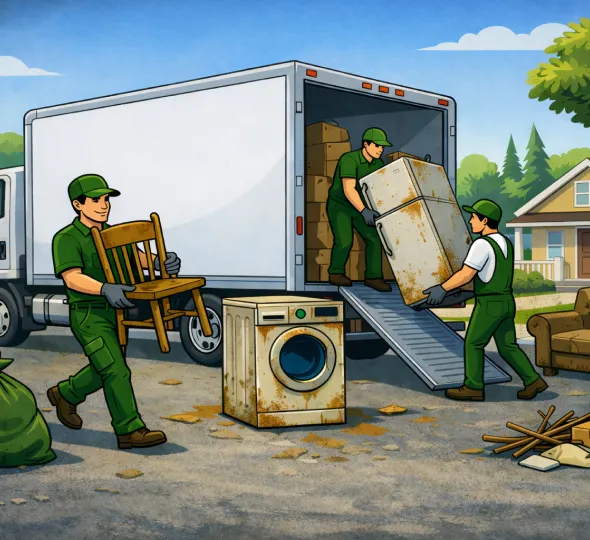
Our Atlanta Residential & Commercial Junk Removal Services
Atlanta Specialty & Other Junk Removal Services
Why Choose Atlanta Junk Removal Services
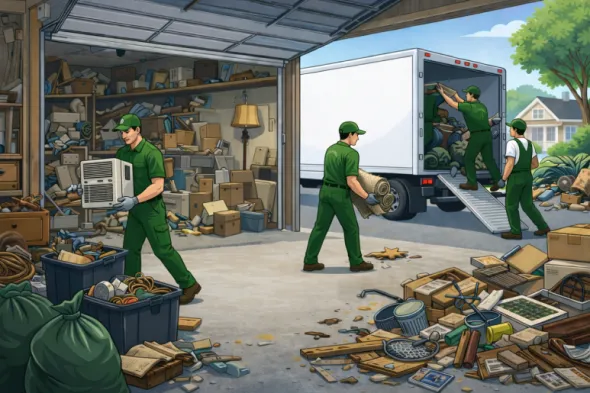

Comprehensive Junk Removal Solutions
-
Competitive Pricing
-
Experienced Professional Team
-
Satisfaction Guarantee
-
Personalized Service
-
Eco-Friendly Disposal
-
Fast and Reliable Scheduling
Understanding Atlanta's Waste Management Infrastructure & Municipal Disposal Requirements
Atlanta's solid waste services operate under the Atlanta Department of Public Works, which oversees curbside collection, bulk waste pickup, and coordination with private haulers across the city. The City of Atlanta provides weekly residential garbage and recycling collection on designated routes. Residents must schedule bulk waste pickup by contacting the Department of Public Works directly, as items such as furniture, appliances, and large household goods require advance arrangement. The City operates in coordination with Fulton County and DeKalb County transfer stations for material processing and disposal.
Atlanta Department of Public Works
55 Trinity Avenue SW, Atlanta, GA 30303
Phone: (404) 330-6333
Official Website: Atlanta Department of Public Works
- Curbside garbage and recycling collection occurs weekly on assigned routes
- Bulk waste pickup requires advance scheduling through the Department of Public Works
- Yard waste must be bundled or bagged separately from household refuse
- Illegal dumping violations carry fines enforced by Atlanta Code Enforcement
Partnering with Atlanta's Environmental & Recycling Initiatives
Atlanta has committed to diverting waste from landfills through its residential recycling program and partnerships with nonprofit reuse organizations. The Georgia Environmental Protection Division regulates solid waste management statewide, including landfill permitting and material recovery standards. Georgia does not currently operate a statewide mattress Extended Producer Responsibility program; however, residents can drop off mattresses at area transfer stations for a fee or coordinate retailer take-back upon new mattress delivery. Donation-ready furniture and household goods can be directed to Atlanta Habitat for Humanity ReStore locations or local Goodwill and Salvation Army centers.
- Atlanta's curbside recycling program accepts paper, cardboard, glass, metal cans, and plastics #1–#7
- Georgia does not impose a statewide landfill ban on electronics, but the EPD encourages responsible e-waste recycling
- Habitat for Humanity ReStore accepts usable furniture, appliances, and building materials
- Scrap metal recycling facilities throughout metro Atlanta accept ferrous and non-ferrous metals
Atlanta Municipal Regulations & Permits for Junk Removal Services
Junk removal operators working within Atlanta must comply with municipal licensing, right-of-way permitting, and code enforcement requirements. Dumpster placement on public streets or sidewalks requires a right-of-way permit issued through the City of Atlanta. Permit applications are processed through Atlanta Buildings & Zoning, and applicants should allow 5–10 business days for review. Waste haulers operating commercially within city limits must maintain valid business licenses and proof of liability insurance. Properties located within designated historic districts, such as Inman Park or Grant Park, may require additional approvals before exterior demolition debris removal.
Atlanta Inspections & Code Enforcement
55 Trinity Avenue SW, Suite 3900, Atlanta, GA 30303
Phone: (404) 330-6190
Official Website: Atlanta Inspections & Code Enforcement
- Right-of-way permits for dumpster placement typically range from $50–$200 depending on duration and location
- Commercial waste haulers must hold a valid City of Atlanta business license
- Historic district properties require review by the Atlanta Urban Design Commission before exterior work
- Code enforcement officers may issue citations for unpermitted street obstructions or illegal dumping
Appliance Removal & Refrigerant Recovery Requirements in Atlanta
Federal law under EPA Clean Air Act Section 608 mandates that certified technicians recover refrigerants from appliances before disposal. Refrigerators, freezers, window air conditioning units, and dehumidifiers all contain regulated refrigerants that must be captured using approved recovery equipment. Atlanta-area transfer stations and scrap metal facilities require proof of refrigerant evacuation before accepting white goods. Violations of Section 608 carry federal penalties of up to $44,539 per day per violation. The EPA Region 4 Southeast office, headquartered in Atlanta, oversees federal environmental compliance for Georgia.
- Refrigerant recovery must be performed by EPA Section 608-certified technicians
- Covered appliances include refrigerators, freezers, air conditioners, dehumidifiers, and heat pumps
- Transfer stations require documentation of refrigerant removal before accepting white goods
- Improper venting of refrigerants is a federal violation under the Clean Air Act
Hazardous Waste Restrictions & Proper Disposal Channels in Atlanta
Atlanta residents and businesses must follow Georgia and federal regulations when disposing of hazardous materials. The Resource Conservation and Recovery Act (RCRA) establishes the federal framework for hazardous waste management, and the Georgia Environmental Protection Division enforces state-level compliance. Fulton County hosts periodic Household Hazardous Waste (HHW) collection events where residents can drop off paint, solvents, pesticides, batteries, and fluorescent bulbs at no charge. The EPA Universal Waste Rule governs the handling of batteries, mercury-containing devices, and fluorescent lamps. Properties built before 1978 may contain lead-based paint; renovation and demolition work on these structures must comply with the EPA Lead Renovation, Repair & Painting (RRP) Rule.
Georgia Environmental Protection Division
2 Martin Luther King Jr. Drive SE, Suite 1462, Atlanta, GA 30334
Phone: (404) 656-4713
Official Website: Georgia Environmental Protection Division
- Prohibited curbside items include paint, motor oil, batteries, pesticides, and fluorescent tubes
- Fulton County schedules HHW collection events several times per year; check the county website for dates
- Businesses generating hazardous waste must register with the Georgia EPD and maintain proper manifests
- Pre-1978 demolition debris may require lead paint testing and certified abatement procedures
Seasonal Waste Patterns & Weather Considerations in Atlanta
Atlanta's humid subtropical climate produces distinct seasonal waste patterns that affect junk removal scheduling and logistics. Summer temperatures regularly exceed 90°F, creating urgency for appliance disposal to prevent refrigerant leakage and pest attraction. Spring and fall generate significant yard waste volumes, particularly from Atlanta's dense tree canopy; the Atlanta Arborist Division regulates tree removal and requires permits for trees with a diameter at breast height of six inches or greater. Severe thunderstorms and occasional ice storms produce debris that strains municipal collection capacity, and post-storm cleanup often requires coordination with the Department of Public Works.
- Summer heat accelerates decomposition of organic waste and increases pest risks during removal delays
- Spring cleaning season (March–May) generates peak residential junk removal demand
- Atlanta receives approximately 50 inches of rainfall annually, requiring covered transport for debris
- Post-storm tree debris removal may require an arborist permit for trees on public or private property
- University move-out periods near Georgia Tech and Georgia State University create localized waste surges in May and August
What Neighborhoods Do We Serve Throughout Atlanta, GA?
Downtown Atlanta: High-density commercial and residential core with limited street parking; coordination with City right-of-way permits is required for curbside removal near Peachtree Street and Marietta Street.
Buckhead: Upscale residential and commercial district featuring high-rise condominiums and large single-family estates; elevator access coordination and HOA approval are frequently necessary for removal projects.
Midtown Atlanta: Dense mixed-use corridor along Peachtree Street with mid-rise and high-rise buildings; loading dock scheduling and building management coordination are essential for efficient service.
Inman Park: Atlanta's first planned suburb, designated as a historic district; special permits may be required for demolition debris removal from Victorian-era homes built in the 1880s–1900s.
Grant Park: Historic residential neighborhood adjacent to Zoo Atlanta with narrow residential streets and pre-1920 bungalows; lead paint and asbestos considerations apply to renovation debris from older structures.
West End: One of Atlanta's oldest neighborhoods with a mix of historic homes and new infill construction; the Atlanta Office of Housing & Community Development supports revitalization efforts that generate construction and cleanout debris.
Virginia-Highland: Established residential neighborhood with mature landscaping and narrow side streets; large furniture and appliance removal projects benefit from driveway access where available.
Commercial Waste Management Solutions for Atlanta Businesses
Atlanta's commercial sector generates substantial waste volumes from office cleanouts, restaurant equipment removal, retail fixture disposal, and tenant turnover in multi-unit properties. Commercial waste haulers must comply with City of Atlanta business licensing requirements and maintain appropriate insurance coverage. Property managers overseeing apartment complexes and condominium buildings should coordinate bulk removal schedules with building management to secure loading dock access and elevator reservations. Construction and renovation projects require building permits through Atlanta Buildings & Zoning, and demolition debris must be sorted to separate recyclable materials such as clean wood, metal, and concrete from mixed waste destined for landfill disposal.
Atlanta Office of Zoning & Development
55 Trinity Avenue SW, Suite 3350, Atlanta, GA 30303
Phone: (404) 330-6145
Official Website: Atlanta Office of Zoning & Development
- Commercial tenants must verify lease terms regarding waste removal responsibilities before scheduling service
- Multi-unit properties require building manager authorization and loading dock scheduling
- Construction debris sorting separates clean wood, metal, concrete, and drywall for recycling
- Zoning compliance review may be required for properties undergoing change-of-use renovations
How Georgia Statewide Waste Reduction Goals Impact Atlanta Services
Georgia's Comprehensive Solid Waste Management Act requires each county and municipality to develop and maintain a solid waste management plan addressing collection, disposal, and waste reduction. The Georgia Environmental Protection Division oversees plan compliance and landfill permitting statewide. Atlanta falls within both Fulton County and DeKalb County solid waste planning jurisdictions, and residents should confirm which county manages their area's transfer station access. The EPA Region 4 Southeast office, located at 61 Forsyth Street SW in Atlanta, provides federal regulatory guidance for businesses handling universal waste, hazardous materials, and interstate waste transport.
- Georgia requires local governments to submit updated solid waste management plans to the EPD
- Fulton County and DeKalb County each operate transfer stations serving Atlanta residents
- The state encourages a 25% waste reduction goal through source reduction and recycling programs
- Interstate transport of solid waste is regulated under both RCRA and Georgia state law
- Businesses generating more than 220 pounds of hazardous waste per month must register as small quantity generators with the Georgia EPD